
Skip to content
  • Free written quotes
  • Local painters
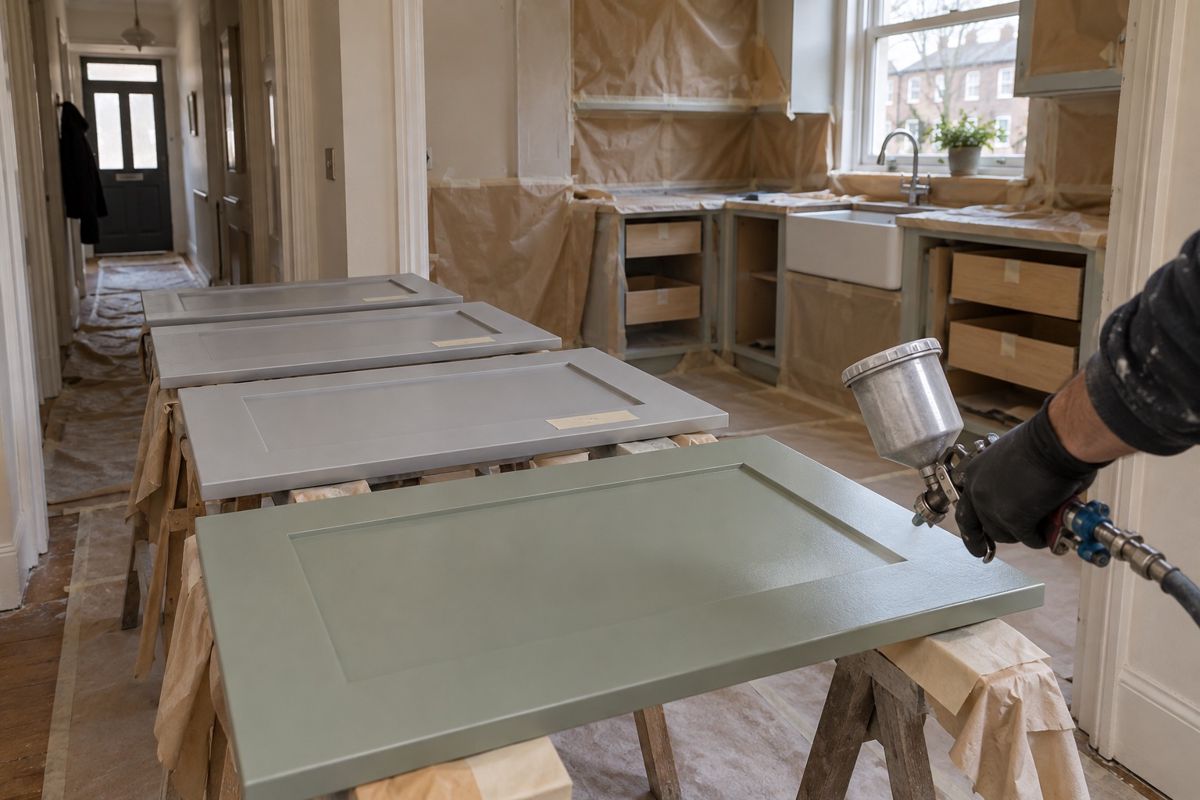
Shaker kitchen cabinet doors being spray painted sage green in London

Cabinet painting in London

Kitchen cabinet painting in London without a new kitchen

Spray or brush finishes on the doors, drawer fronts and frames you already have, in colours that suit your kitchen.

  • Spray or brush finishes
  • Existing doors and frames refinished
  • Colour advice for small, dim kitchens

Step 1 of 3

What needs painting?

What is kitchen cabinet painting?

Kitchen cabinet painting means refinishing the doors, drawer fronts and frames you already have instead of replacing the whole kitchen. If the units are solid and well built, a new finish can change how the kitchen looks with far less disruption than a rip-out.

The usual steps are:

  1. Remove doors, drawers and handles, and label them so they go back in the right place.
  2. Clean off grease and wax, which is the main reason cabinet paint fails.
  3. Sand to give the surface a key, and fill any dents or open grain.
  4. Apply a bonding primer.
  5. Apply two or more coats of a hard-wearing cabinet paint, sanding lightly between coats.
  6. Leave the finish to harden, then refit the hardware.

New handles and hinges are not part of the finish itself, but they are easy to swap at the same time.

Is spraying better than brushing for kitchen cabinets?

Both methods can work. The right choice depends on your kitchen and your priorities.

Spray finishing

Spraying usually gives the smoothest, most even surface, with no brush marks. It needs careful masking of the room, or in some cases the doors are taken to a separate workshop. Sprayed doors need time to harden before they are refitted, so planning matters, and the kitchen may be without doors for a while.

Brush and roller finishing

Brushing and rolling are done in your kitchen with less masking. A fine foam roller and good paint can leave a very neat finish, though it may show faint texture up close. It is a sensible choice for smaller jobs or when the doors cannot leave the house.

Whichever method is used, ask which paint is planned. Hard-wearing water-based enamels and two-pack finishes are made for kitchens. Standard wall paint is not.

Which London kitchens suit painting, and which do not?

Solid wood and good-quality MDF doors usually paint well. Shaker-style doors, with their raised panels and inside corners, need extra care in the grooves, but they paint nicely when prepared properly.

Some cabinets are harder to deal with:

  • Thermofoil and plastic-wrapped doors can peel, and may need replacing.
  • Laminate can be painted with the right primer, but the edges take a lot of wear.
  • Water-damaged chipboard that has swollen cannot be repaired with paint.
  • Worn hinges and runners are better replaced at the same time.

Many London kitchens are small, in terraces, mansion blocks and converted flats, with limited daylight. Lighter colours help, and a satin or eggshell look is easier to wipe clean than a flat matt one. A kitchen with steam from a cooker and kettle needs a tough finish and a working extractor. Paint a sample on one door and look at it in morning and evening light before you decide.

Every kitchen is different, so we quote in writing after seeing it. The main things that change the price are:

  • The number of doors, drawer fronts and panels
  • Whether there is an island, a pantry or tall units
  • The condition of the existing finish and any repairs needed
  • A big colour change, such as dark to light, which takes more coats
  • Whether the insides of the units are painted as well as the fronts
  • Spray finishing compared with brush and roller
  • Whether handles and hinges are replaced during the job

A cabinet repaint costs less than a new kitchen in most cases, but it only makes sense where the units themselves are sound. Ask each painter what paint system they use, how many coats are included and how long the finish needs to harden. If other rooms need work too, our interior painting page explains how that is quoted.

How long does it take, and when should I call?

A typical kitchen often takes about a week once everything is stripped back, spread across preparation, priming and the coats, with drying time between each. The finish feels dry soon but takes longer to reach full hardness, so go gently for the first couple of weeks. Avoid harsh cleaners and do not stack things against the doors.

During the work, the kitchen is partly or fully out of use. Plan for a microwave and kettle in another room and somewhere to keep crockery. Keep the room ventilated while the paint cures.

Call when door edges are worn, the finish is yellowing or chipped, or you like the layout but not the colour. If you also want the front door to match, see exterior house painting, or go back to the home page to see everything we do. You can also call 020 7946 0840.

What you can expect

  • Free written quotes

  • Local painters

  • Careful prep

  • Tidy finish

Questions about painting in London

Will painted kitchen cabinets chip?

Any painted surface can chip in a busy kitchen, but a proper cabinet system keeps this to a minimum. Good preparation, the right primer and a hard-wearing paint are what matter most. Edges, handles and the doors beside the cooker take the most wear. Avoid harsh scrubbing, and ask about touch-up paint at the end of the job.

Can you paint laminate or thermofoil cabinets?

Laminate can often be painted with the right bonding primer, but results depend on the condition of the surface. Thermofoil is harder, since the plastic skin can peel and lift. We would look at a sample door first and tell you plainly if replacement doors make more sense than painting.

Do I have to empty all my cupboards?

Yes, at least the ones with doors being removed and any drawers being painted. Drawer contents are best boxed up beforehand. If the insides of the units are included, they must be fully empty. Clearing the kitchen the day before the start saves time and reduces the chance of anything getting marked.

How do I choose a colour for a small kitchen?

Light, warm colours bounce daylight around, which helps in dim London kitchens. Deeper colours can look striking but make small rooms feel tighter. Paint a large sample on a door, or a board, and check it in morning, afternoon and evening light, and under your kitchen lights, before making the final choice.

Is a cabinet repaint cheaper than a new kitchen?

In most cases it costs less, and it creates less mess and disruption. It makes sense when the units, worktops and layout still work for you. If the carcasses are damaged, the layout is wrong or the doors are swollen, new units may be the better long-term choice. We will tell you honestly which it is.

Request cabinet painting

Tell us what you need and we call you back.

Step 1 of 3

What needs painting?

No obligation.

Ready when you are

Call now or request a quote online.

020 7946 0840

How it works

1

Tell us about the job

Rooms or exterior, colours and timing.

2

Visit and written quote

We measure and price it in writing.

3

Prep, paint, tidy up

Floors and furniture protected, clean lines, cleanup.